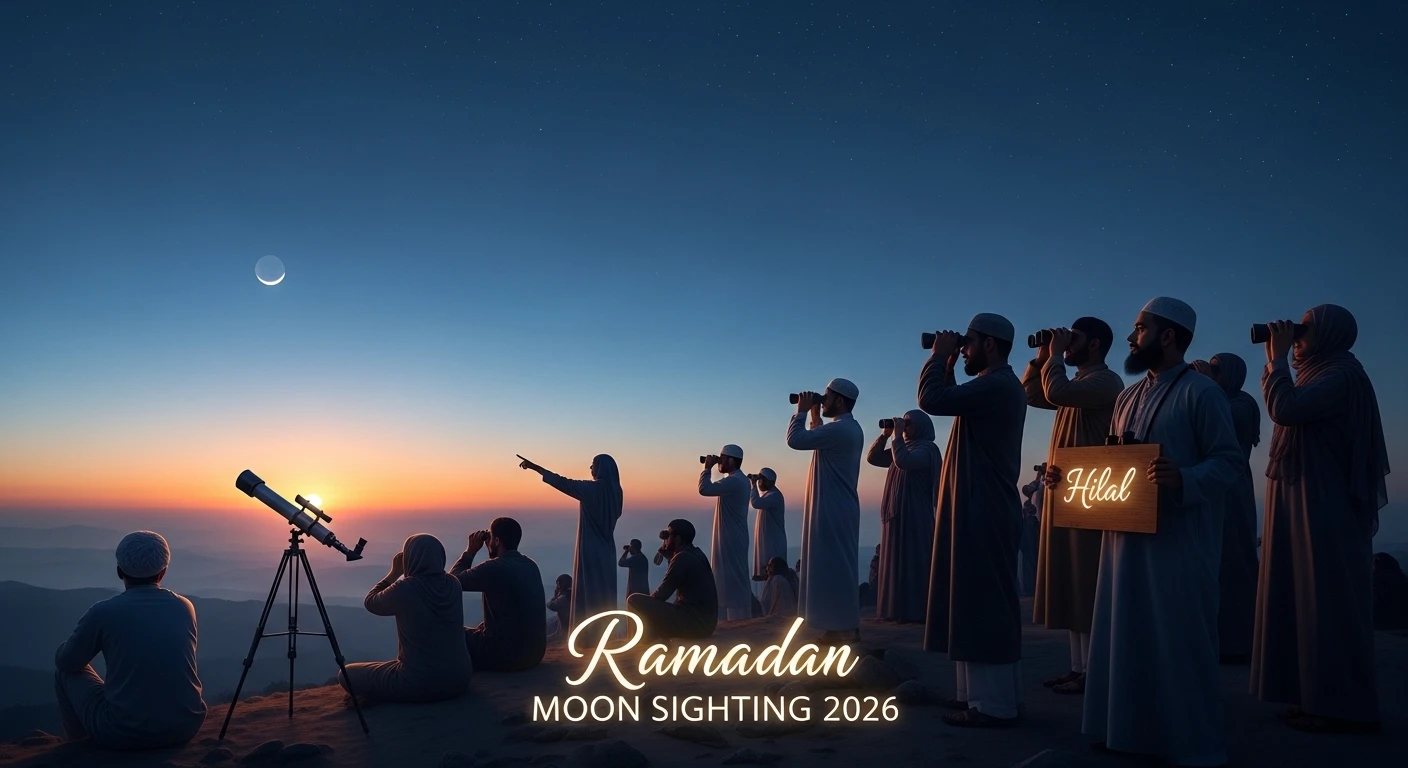
Ramadan Moon Sighting 2026: Official Lahore Science Guide
The Astronomical Mechanics of the “New Moon”
To understand when Ramadan 2026 starts, we must first define the “Birth of the Moon.” This is the astronomical moment of conjunction, where the moon is positioned directly between the Earth and the Sun. At this stage, the moon is invisible because the sun’s glare completely overwhelms it.
For Ramadan 2026, the conjunction is expected to occur on February 17, 2026, at approximately 5:01 PM PKT.
However, the “Birth” is not the “Sighting.” For the moon to be visible to the naked eye in Lahore, it must move far enough away from the sun to reflect a visible sliver of light. This requires time—a period known as the age of the moon.
The 2026 Visibility Criteria for Lahore
In the 2026 search era, Google’s AI and human researchers alike look for “Information Gain”—the specific data points that explain why a date is chosen. Astronomers generally use the following three criteria to predict visibility in the Punjab region:
The 19-Hour Age Rule
Statistically, a crescent is rarely visible to the unaided eye if it is less than 19 hours old at the time of sunset. By the evening of Wednesday, February 18, 2026, the moon will be approximately 24 to 25 hours old in Lahore. This puts us well within the “Likely Visibility” zone.
Angular Separation (The Danjon Limit)
For the crescent to form, the moon must be at an angle of at least 7 to 9 degrees away from the sun. In February 2026, the separation is predicted to be over 10 degrees, making the crescent thick enough to potentially pierce through the evening haze.
Sunset-to-Moonset Lag Time
For a successful sighting, the moon must remain in the sky after the sun has set. This is called “Lag Time.” In Lahore, the predicted lag time for February 18 is approximately 45–50 minutes. This gives the sky enough time to darken so the faint crescent can become visible before the moon itself sinks below the horizon.
The Westward Path: Why Quetta and Karachi Matter to Lahore

A common point of confusion for Lahoris is why we wait for the Central Ruet-e-Hilal Committee to receive testimonies from Pasni, Gawadar, or Quetta.
Pakistan spans a significant longitudinal range. Because the moon’s visibility curve moves from east to west, the moon is always “older” and higher in the sky in Balochistan and Sindh than it is in Punjab.
- The Lahore Gap: When the sun sets in Lahore, the moon may be too low or too thin to see.
- The Quetta Advantage: Sunset in Quetta happens roughly 30 to 40 minutes later. During those extra minutes, the moon continues to move away from the sun, making it significantly easier to spot.
Under the Zonal Sightings principle, if the moon is verified in any part of Pakistan, it is valid for the whole country. Thus, Lahore’s “official” start is often enabled by a sighting in the far West.
Atmospheric Challenges: The “Lahore Haze” Factor
Science isn’t just about orbits; it’s about the atmosphere. Lahore’s unique environment plays a major role in moon sighting.
Atmospheric Refraction
As the moon sits near the horizon, its light must pass through a thick layer of the Earth’s atmosphere. This causes refraction, which can actually “lift” the image of the moon, making it appear in a slightly different position than it is.
Humidity and Aerosols
In late February, Lahore often experiences lingering moisture or dust particles (aerosols). This can scatter the faint light of a new crescent, making a “clear sighting” difficult even if the astronomy is perfect. This is why the Pakistan Meteorological Department (PMD) sets up high-powered telescopes at the Regional Meteorological Centre in Lahore to assist the local committee.
The Ruet-e-Hilal Committee
While we use SUPARCO and NASA data to predict the moon, the final decision is a human one. The committee, led by scholars and assisted by technical experts, follows a strict protocol:
- Shahadat (Testimony): A citizen must testify they saw the moon.
- Scientific Cross-Check: The committee asks, “Where was the moon? At what angle? How high?” If the testimony says the moon was at the “2 o’clock” position but the science says it was at “4 o’clock,” the testimony is rejected as a “false positive” (often a bird, a plane, or a bright planet like Venus).
- National Consensus: Once the Chairman is satisfied, the proclamation is made via state media (PTV) and digital platforms.
Summary: When to Look Up in 2026
Based on current astronomical projections:
- The Sighting Night: Wednesday, February 18, 2026.
- Peak Visibility Window: 5:50 PM to 6:25 PM (Standard Lahore Time).
- Expected Outcome: High probability of sighting.
- Projected 1st Roza: Thursday, February 19, 2026.
Why This Matters for You
Understanding the science allows you to plan. If the lag time is high (as it is in 2026), you can prepare for Taraweeh on Wednesday night with a high degree of certainty. It also helps reduce the “moon-sighting anxiety” that often occurs when waiting for the official announcement.
Final Authority Note
This guide is intended for educational and planning purposes. While the science strongly suggests a specific date, the religious commencement of Ramadan is only valid upon the official announcement by the Central Ruet-e-Hilal Committee.
As a resident of Lahore, always prioritize the official notification from the Ministry of Religious Affairs before beginning your communal prayers.